

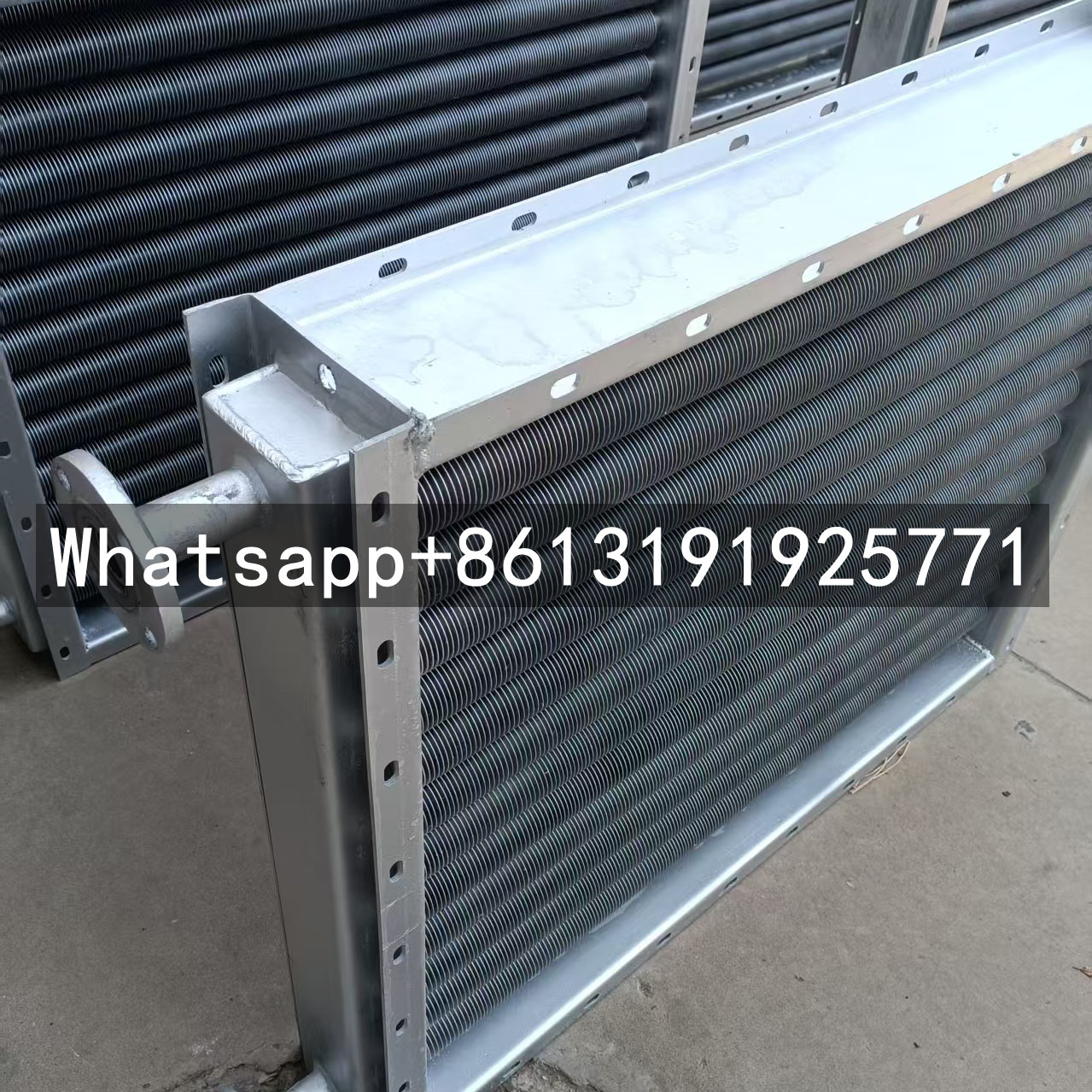
The galvanizing is there for one reason: a greenhouse is one of the most corrosive dry-ish atmospheres you'll find in agriculture — 80–95 % RH, ammoniacal fertiliser dust, chlorinated irrigation water, fungicide sprays, and repeated wet/dry cycling whenever the heating cuts out and the pipes sweat. Bare black-steel fin tube in that environment is rusted through in two or three seasons; hot-dip galvanizing (HDG) on both tube and fins typically gives 15–25 years in humid, mildly corrosive service.
The cost is thermal: galvanizing dips the assembled tube-plus-fin, so a zinc film sits in the fin-to-tube contact joint. That seals out corrosion but adds contact resistance — a few percent of output versus a bare mechanically-bonded fin. And zinc is a far worse conductor than steel or aluminium, so the galvanized steel fin is roughly one-third the conductivity of an aluminium fin of the same shape. You compensate with area, not material.
Coating limit. Hot-dip galvanized steel has a recommended maximum continuous operating temperature of 200 °C (392 °F). Above that the free-zinc layer spalls away from the underlying zinc–iron intermetallic layers. For hot-water greenhouse duty (60–90 °C) you are nowhere near it — but it becomes live in three situations:
Fin-connection limit, which is much lower. This is the one people miss. The coating survives; the fin bond doesn't. Chinese industry guidance on finned-tube temperature ceilings puts spiral-wound L-foot / LL-type fins at only 130 °C, against 400 °C for embedded (G-type) and welded types, and 300 °C for bimetal rolled (DR). So a cheap galvanized spiral-wound fin tube — the most common greenhouse import — degrades at a temperature your coating is happily fine with, because the winding relaxes and contact resistance soars. Buy the fin bond for your worst credible case, not your normal case.
| Source / product | Geometry | Rating condition | Output |
|---|---|---|---|
| UConn IPM, high-output fin pipe | 1¼″, 38 fins/ft of 4¼″ square fins | 180 °F (82 °C) water | ~1200 Btu/h·ft ≈ 1.15 kW/m |
| Chinese DN65 spiral fin, galvanized | 翅距 12 mm, 翅高 14 mm | 95/70 °C, 18 °C room | 0.4–0.6 kW/m |
| Aluminium extruded under-bench (e.g. Delta Fin) | low-output class | up to 110 °C water | per vendor curve |
Those two figures look contradictory and aren't — the 1¼″ high-density fin pipe has ~50 % more fin area per metre than a DN65 at 12 mm pitch, and smaller tube means thinner fin root. The lesson is that fins per metre and fin area per metre are the product you're buying; the pipe diameter is nearly irrelevant to output and mostly decides your water volume and pressure drop.
Output does not scale linearly with water temperature. Natural-convection output goes roughly as ΔT^1.2, and the radiant share from the bare tube is roughly linear. Normalising the UConn rating (ΔT ≈ 61 K) downward:
| Mean water temp | ΔT vs 21 °C house | Approx. output vs rating |
|---|---|---|
| 82 °C | 61 K | 100 % (1150 W/m) |
| 65 °C | 44 K | ~70 % (≈800) |
| 55 °C | 34 K | ~51 % (≈590) |
| 45 °C | 24 K | ~34 % (≈395) |
| 35 °C | 14 K | ~19 % (≈215) |
(This table is my own extrapolation from the 82 °C rating using a natural-convection exponent — treat as an estimate, not vendor data.)
This is why Rafferty's OSTI review states flatly that finned pipe "is not a particularly good choice for low-temperature resources." And it's directly relevant to Hebei: if you're converting from coal to an air-source heat pump, your flow/return will be 40/35 °C or 45/40 °C, not 80/60 °C. A fin-tube run sized off a 95/70 °C datasheet will deliver about one-third of the heat you paid for.
The proven fix for that regime is not more pipe — it's a fan. The documented low-grade installs (geothermal at 27 °C / 81 °F, and power-plant condenser water at 29.4 °C) both hit 100 % of annual greenhouse heat only by putting the finned coils in forced-air ducts, where air-side h goes from ~6 to ~40 W/m²·K. Above ~55 °C mean water, natural-convection galvanized fin pipe is the right answer; below it, either triple the length or move to a fan-assisted unit-heater/coil.
Water volume. DN65 fin pipe holds about 3 L/m. A 60 m loop is ~180 L of water — long under-bench loops are thermally heavy and slow to respond, which fights the whole point of responsive climate control. Split into more, shorter loops.
Balancing. Long unequal loops will not self-balance. Manual valves are decorative here; you need preset balancing valves per loop.
Never share a circuit with copper. Zinc is anodic to copper, and copper ions plated onto zinc cause rapid, localised zinc dissolution — pinhole leaks in a few years. If the boiler heat exchanger or make-up line is copper, insert a plate heat exchanger and run the greenhouse loop as an isolated secondary circuit.
Zinc is amphoteric. It's attacked below pH ~6 and above ~12.5. So: no caustic/alkaline cleaning of the pipes, and use an inhibitor dosed to pH 8–10, not a high-alkalinity one. Ammonia in concentrated wet form also attacks zinc — worth watching surfaces near the fertigation mixing bench.
Galvanized + aluminium is safe (aluminium is also anodic, so zinc stays cathodic-ish); galvanized + 304 stainless in the same loop is the other one to isolate.
Maintenance. Fins collect leaf litter, aphid mummies and algicide deposits. Low-pressure water and a brush only — a pressure washer folds 0.3 mm fins flat and you'll lose more output than the dirt was costing you. Fins cannot be cleaned as effectively as smooth pipe, which is the honest argument for smooth pipe in nurseries with heavy debris.
| Option | Verdict in a greenhouse |
|---|---|
| Galvanized steel fin tube | Best corrosion-per-yuan; needs more area than al; dusty fins; don't run it on heat-pump temperatures |
| Aluminium extruded fin pipe | ~3× conductivity, lighter, more responsive; weaker against wet ammonia and high pH — avoid in manure/ammonia-heavy houses |
| Smooth bare pipe | 3–6× less output/metre, but cleanable, cheap, and the best radiant-to-pot profile under benches |
| Forced-air fin coils | The only good answer below ~50 °C mean water; adds fan capex, noise, stratification |
| 304 stainless fin tube | Genuinely better in chlorinated/coastal irrigation water, but 5–10× cost and can pit under cyclic wetting |
If you tell me the house type, floor area, heat source and its flow/return temperatures, I can work out whether galvanized fin tube is the right emitter for your case or whether you'd be throwing money at a coil that only delivers a third of its rated output.
